The Science Behind Multisensory Processing and Learning
A Foundation Laid in Silence
The brain begins to function before a child learns how to talk or read words and write numbers. It listens, it watches, it balances. The earliest foundation of learning emerges from our senses which operate separately while being deeply connected. This is multisensory processing: Sight, sound, touch, and movement work together in silent coordination to function automatically before conscious thought develops.
During an infant’s initial months of life they develop a fluent ability to process sensory information. A glance stabilizes balance. A sound turns the head. Contact with the hand creates awareness of someone’s presence beyond recognizing its texture. Learning starts as natural instinct which involves multiple senses before becoming effortful.
When Input Becomes Effort
The world loses its wholeness when this system stops functioning properly. Students who have difficulty sitting still or reading aloud in class show learning challenges because their brain needs to work harder to replace skills it didn’t fully develop automatically.
Adults may face similar disruptions. After sustaining a concussion individuals often experience pain when exposed to light. Motion feels disorienting. Driving demands deliberate attention when it used to be automatic. Friction now stands where ease once operated. The disruption of multisensory processing remains hidden from view yet creates significant impact.
The Unseen Architecture of Learning
The essential process at hand operates beyond academia because it functions through architectural principles. It underlies attention, memory, language, emotion. Both educational systems and therapeutic approaches from the top remain largely unaware of this fundamental process. Layering strategies on compromised integration building blocks becomes ineffective and frustrating.
Learning fundamentally begins with multisensory processing rather than serving as a mere support for learning. Partial restoration of the system reopens its inherent neural pathways to promote growth.
Restoring the Original Language
MST focuses on restoration rather than teaching new material. It reintroduces rhythm. Passive subcortical stimulation methods like light and motion activate the same neural pathways that facilitated initial brain development.
This is not regression. It is restoration. During the measured quiet of restoration a change starts to happen. Balance returns. Focus lengthens. The effort lifts.
Learning becomes possible once more in that lift because it restores the original effortless state which did not require effort.
What Is Multisensory Processing?
A Convergence of Senses
Multisensory processing extends beyond simultaneous visual and auditory experiences. The brain processes multiple sensory inputs by merging them together to create a single unified experience. Multisensory processing enables children to simultaneously catch a ball and navigate a crowded hallway while understanding spoken language and watching written text.
The brainstem and midbrain which control automatic regulation and reflexive coordination serve as the starting point for sensory convergence. Through the thalamus which serves as the brain’s relay hub sensory signals reach their destination before spreading to higher cortical areas. Integration emerges through multiple layers that increase in complexity over time.
A healthy network enables the brain to perform fluently within its environment. Minor disruptions in neural processes can lead individuals to experience difficulties with orientation as well as timing, attention, and interpretation.
The Circuitry of Integration
The superior colliculus which resides deep within the midbrain structure serves as the central mechanism for merging visual, auditory, and somatosensory information. Neurons here are specialized for detecting cross-modal events: The superior colliculus detects multisensory events such as simultaneous visual flashes with auditory bangs and tactile movements with physical touches. The most reliable activation of these multisensory neurons occurs when the brain receives simultaneous input from several senses which strengthens the meaning of an event.
Biological redundancy serves vital evolutionary functions. The system provides quick detection capabilities along with fast responses and efficient movement through the environment. The system establishes foundational learning capabilities by enabling the cortex to work with processed information instead of raw input.
The ability of the brain to process information efficiently enables reading, listening, movement, and social interaction to occur seamlessly without needing conscious computation.
Automaticity vs. Compensation
People with complete multisensory pathways process integrations automatically. They require no deliberate thought. Whenever the system remains underdeveloped or experiences injury-induced disruption compensation mechanisms initiate. The brain may develop excessive dependence on a single sensory input channel. Children can find eye contact overwhelming which leads them to avoid it. Students who depend on rote memorization often exhibit this behavior due to their weak auditory processing abilities.
These behaviors should not be mistaken for laziness or inattention. These are indications that the system has to make do with improvised solutions because it lacks coherent functioning.
Beyond the Senses
People frequently misinterpret multisensory processing as just sensory. The influence of multisensory processing covers multiple domains including balance along with emotional responses and cognitive functions. This system determines our spatial movement patterns while also managing our energy levels and social responses alongside our ability to concentrate.
When the system breaks down it can cause symptoms such as restlessness alongside anxiety and difficulties with reading and memory and lead to chronic fatigue. The restoration of multisensory fluency leads to comprehensive enhancements spanning perception abilities along with functional performance and emotional wellbeing.
The unseen framework that supports most of our learning process remains hidden from view. This system works alongside cognition to ready the mind for complete engagement.
Multisensory Processing in Development
The Early Learning System
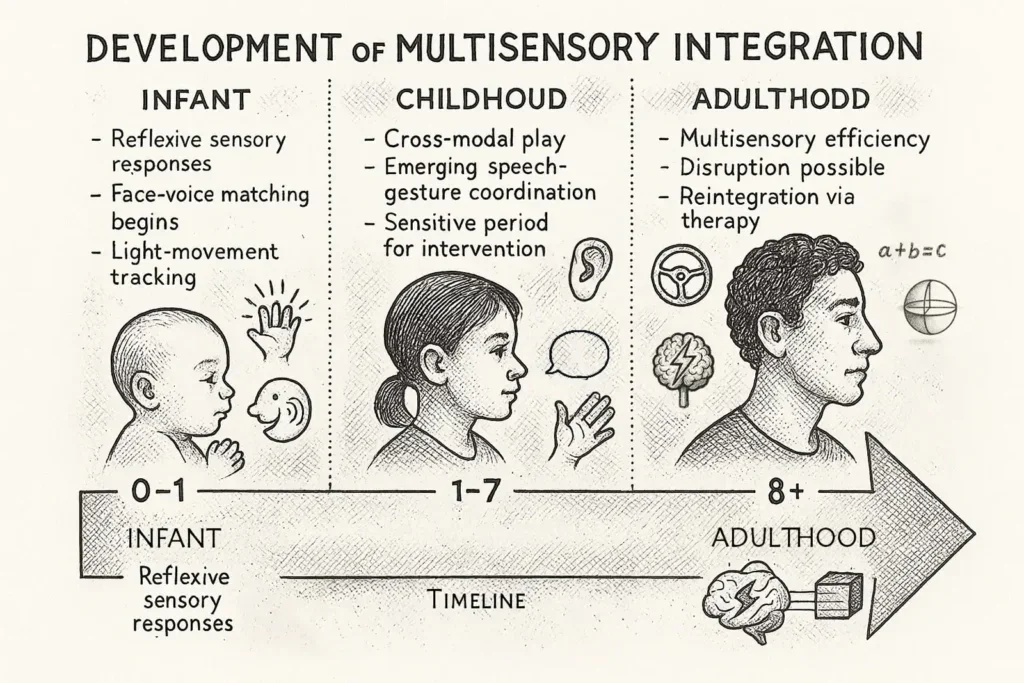
Before children understand language or numbers they experience the world through sensory perception. Multisensory processing functions as the foundational framework for all subsequent learning abilities. Through sensory experiences during infancy the brain develops its architecture which forms neural connections between visual, auditory, vestibular, and tactile systems to create a unified network.
From the time of conception this development starts and proceeds quickly through the first three years after birth. While balancing their head children learn to follow motion with their eyes and to reach toward sounds and respond to caregiver voices by orienting toward faces. These are not isolated feats. Integrated achievements emerge from the brain’s enhanced ability to merge diverse information sources into a unified response.
This system should function automatically when the child turns three years old. At this developmental stage children demonstrate readiness to access complex mental activities through speech and symbolic reasoning as well as peer interaction. If children lack this developmental groundwork they will experience delayed milestones which appear fragmented and require significant effort to accomplish.